
At a glance: a good lesson note commonly records class information, topic and sub-topic, instructional objectives, instructional materials, previous knowledge, lesson presentation or learning activities, and evaluation. Their labels and order differ between schools, so use these as planning functions rather than a universal mandated template.
The seven components and what each one does
1. Class information
Record the identifying details required by your institution, such as school, subject, class or grade, date, term, week and lesson duration. These details place the lesson in the right timetable and help another teacher or supervisor understand which learners the preparation is for.
Check: match the date, class and duration to the actual timetable. A well-written lesson prepared for the wrong class or period still needs correction.
2. Topic and sub-topic
State the broader topic and narrow it to the portion being taught in this period. A topic such as “Plants” may be too broad for one lesson; a focused sub-topic such as “Parts of a flowering plant” gives the teacher and learners a clearer boundary.
Check the scheme of work or other approved sequence so that this lesson follows what learners have studied and prepares for what comes next.
3. Instructional objectives
Describe an action learners can demonstrate by the end of the lesson. Verbs such as identify, explain, compare, calculate, classify and construct make the intended evidence easier to see than broad verbs such as “know” or “understand”. Choose a task that suits the learners’ level and can be achieved in the available time.
4. Instructional materials
List resources that help learners encounter or practise the intended content: real objects, charts, pictures, models, textbooks, worksheets, digital resources or locally available materials. A material belongs in the plan when it supports an objective or activity; a decorative item that is never used adds little instructional value.
Check beforehand that resources are available, safe, suitable for the class and usable in the teaching space. If a planned digital resource depends on internet access, prepare an offline alternative when that access is uncertain.
5. Previous knowledge
Identify the specific knowledge or experience that learners may use as a bridge to the new idea. “Learners know plants” is broad. “Learners can name common plants and describe what plants need to grow” gives the teacher something concrete to check at the start.
Use a short opening question, demonstration or recall task to test the assumption. If learners do not yet have the expected background, adjust the opening and explanation rather than continuing as if everyone is ready.
6. Lesson presentation and teaching and learning activities
Plan how the period will unfold, including the teacher’s actions, learner participation, resources and checks for understanding. A workable sequence often introduces the topic, develops the key ideas, gives learners time to practise, addresses misconceptions and ends with a brief summary.
Make learner actions visible in the plan. Instead of writing only “teacher explains parts of a plant,” specify what learners will do: observe a diagram, label the roots, stem, leaves and flower, compare answers with a partner, and explain one function. Activities should be practical for the class size, time and resources available.
7. Evaluation
Evaluation is the evidence-gathering step. Use a question, written response, practical task, demonstration or other suitable activity that checks the stated objective and fits the time remaining. If the objective asks learners to identify four parts, ask them to identify the parts; if it asks them to explain a function, ask for an explanation.
Use the evidence to decide what to reinforce, clarify or revisit. Asking many questions is not automatically useful if they test unrelated content or do not reveal whether the intended learning occurred.
Check the connection: objective → activity → evaluation
The three most important planning decisions should point in the same direction. Learners need a chance to practise the action named in the objective, and the evaluation should gather evidence of that same action.
| Objective | Practice activity | Evaluation evidence |
|---|---|---|
| Identify four parts of a flowering plant. | Learners observe a plant or diagram and label the roots, stem, leaves and flower. | Each learner labels the four parts on a fresh diagram or identifies them on a plant. |
| Explain one function of the roots. | Learners compare what a plant looks like with and without healthy roots, using a suitable picture or teacher explanation. | Learners state a function of roots in their own words. |
This is a compact illustration, not a complete lesson note. A full lesson plan would also account for class context, timing, the required school format, questions, transitions, likely misconceptions, resources, conclusion and any follow-up work.
Other sections your school may require
Some formats give separate headings to conclusion, assignment, references, teacher reflection, board summary, lesson steps or assessment records. Other formats combine several functions. Terms such as “previous knowledge,” “prior knowledge” and “entry behaviour” may refer to similar ideas. Confirm your school’s expectations instead of assuming one layout applies everywhere.
When checking subject content, use the curriculum and syllabus approved for your class and location. Nigerian teachers can consult the Nigerian Educational Research and Development Council curriculum portal alongside current guidance from their school or relevant education authority.
A quick lesson-note review before teaching
- Are the class, subject, date, topic and duration correct?
- Does the topic fit the approved teaching sequence?
- Can learners demonstrate each stated objective?
- Do the materials directly support the planned learning?
- Is the previous knowledge specific and checked rather than assumed?
- Does the sequence include learner participation and practice?
- Does the evaluation match the objective and fit the remaining time?
- Have you included any additional sections required by your institution?
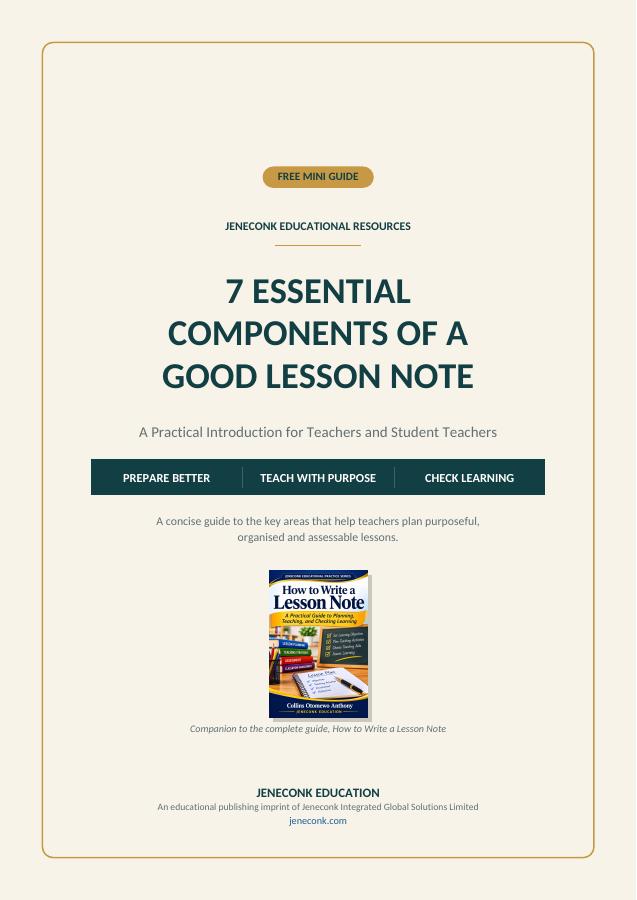
Free PDF · 5 pages
Download the 7 Essential Components mini-guide
Keep the seven components and a practical pre-teaching review checklist nearby. This concise resource is for personal learning and professional development.
Download the free mini-guideWant the complete lesson-planning guide?
This free introduction covers the seven planning functions and one compact alignment example. The complete ebook goes further with worked lesson notes across Primary Mathematics, English Language, Basic Science and Social Studies, a planning laboratory, reusable templates, exercises with answer guidance and classroom strategies.
Choose the format that suits your next step:
Continue learning
- Read the step-by-step free guide to writing a lesson note.
- Browse sample lesson notes.
- Explore Edu Suite 2.0 for teacher-reviewed lesson-note drafting.
Editorial note: This JENECONK Education resource is an educational planning aid. Follow your school’s prescribed format and approved curriculum. It does not replace institutional guidance or professional teacher judgement.